
Part 5 of 5 · The Focus-First Workplace series
Last updated: May 2026 | 6 min read
When companies talk about employee retention, the conversation usually turns to salary, benefits, or perks.
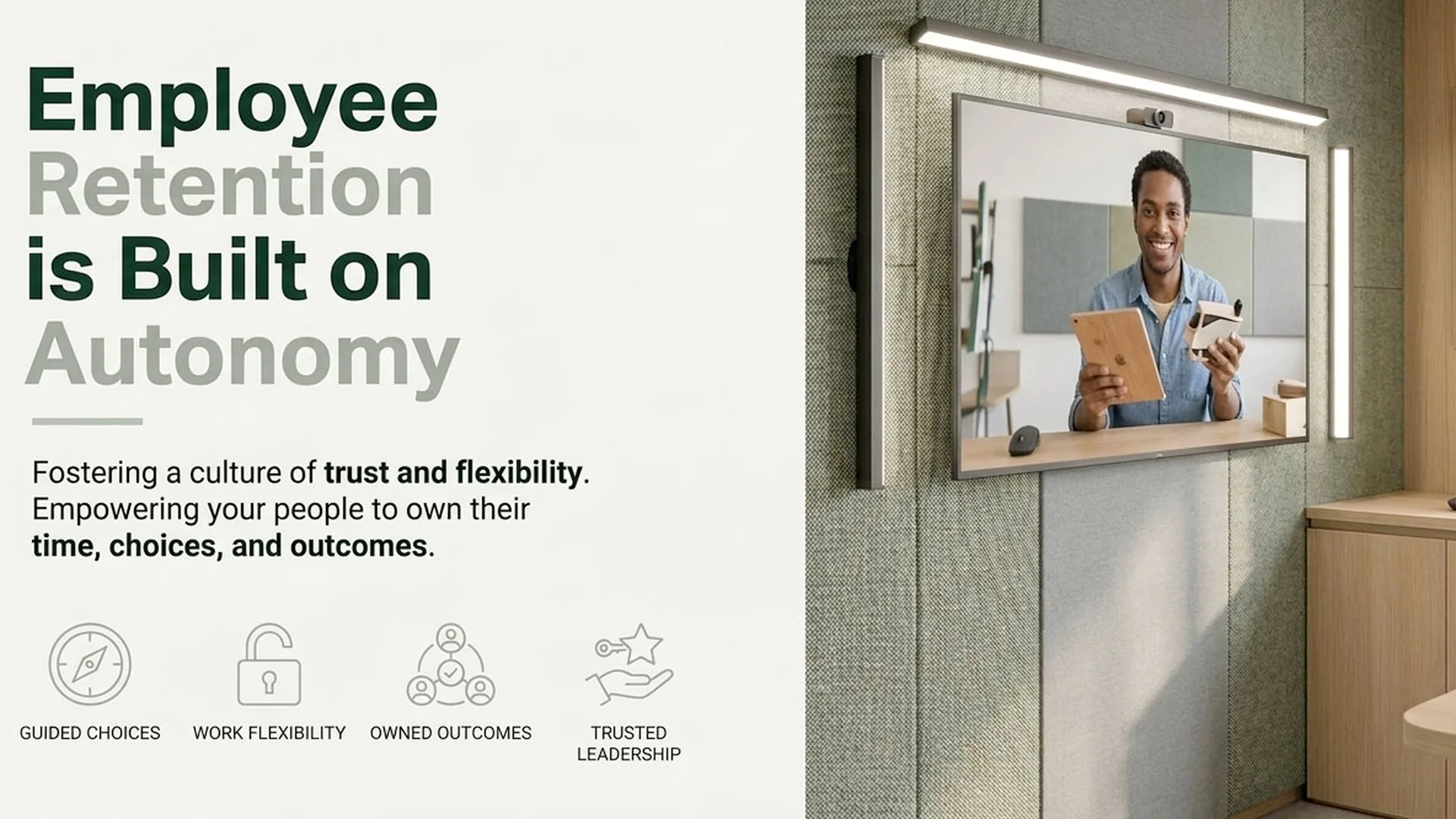
While those things matter, they're rarely the real reason people stay or leave. In reality, one of the strongest predictors of retention is something far less visible: autonomy.
The ability for employees to control how, where, and when they work has become one of the most important factors in workplace satisfaction. And in a hybrid world, it's becoming even more central to how people evaluate their jobs.
People don't just leave roles anymore. They leave environments that feel restrictive.
Retention Has Shifted From Compensation to Control
For a long time, businesses assumed that retention was primarily a financial issue. Increase salaries, improve benefits, offer incentives, and employees will stay longer.
But workplace expectations have evolved.
Today's employees are more likely to prioritise flexibility and trust over purely financial rewards. They want to feel trusted to manage their own time, structure their workday, and choose environments that help them perform at their best.
This shift has been accelerated by hybrid work. Once people experienced greater autonomy working from home — choosing when to focus, when to take breaks, and how to structure their day — many became far less tolerant of rigid, highly controlled office environments.
The expectation has changed permanently.
Autonomy Is Not the Same as Isolation
There is sometimes a misconception that autonomy means working alone or removing collaboration.
That isn't the case. True autonomy is about choice. It's the ability for employees to decide:
- •When to collaborate with the wider team
- •When to focus deeply without interruption
- •Where to take calls or virtual meetings
- •How to manage energy throughout the day
It's not about separating people. It's about giving them control over how they engage with their work.
The most effective workplaces today are those that balance structure with flexibility. They provide frameworks for collaboration, while still allowing individuals to work in ways that suit their tasks and working style.
Why Lack of Autonomy Drives People Away
One of the most overlooked causes of disengagement is the feeling of being constantly interrupted or controlled by the environment.
Open offices without private spaces, rigid desk allocations, and back-to-back meeting cultures all reduce a person's sense of control over their day. Over time, this leads to frustration.
Not necessarily loud frustration, but quiet dissatisfaction that builds gradually. Employees start looking for environments where they can work with fewer interruptions, better focus, and more independence.
In many cases, people don't leave because of one big issue. They leave because of ongoing friction in how they are expected to work.
Autonomy removes much of that friction.
The Role of the Physical Workspace
Workplace design plays a much bigger role in autonomy than many organisations realise. An office layout can either support or restrict how freely employees move between different types of work.
For example, a fully open-plan office with no private spaces limits choice. Employees are forced to adapt their work to the environment, rather than the other way around.
By contrast, flexible workplaces that include meeting pods, quiet zones, collaboration areas, and informal spaces give employees control over their environment throughout the day. This is where physical design and retention intersect.
At Social Space Solutions, we often see businesses rethink their entire layout once they realise that autonomy isn't just a management philosophy — it's also a spatial one.
When employees have access to spaces that support different tasks, they naturally feel more trusted and more in control of their workday.
Hybrid Work Raised the Bar
Hybrid work has fundamentally raised employee expectations around autonomy.
After experiencing flexibility, many employees now see it as a baseline expectation rather than a benefit. The ability to choose where to work — whether at home, in the office, or in a quiet booth — has become part of modern working life.
This doesn't mean the office is less important. In fact, it often means the opposite.
But it does mean the office must earn its place by offering something valuable: environments that support focus, collaboration, and choice better than home can. When offices fail to provide that flexibility, retention often suffers.
Retention Is an Experience, Not a Policy
Many organisations still treat retention as a policy issue — something to be managed through HR frameworks, engagement surveys, and performance systems.
But retention is increasingly an experience issue. It's shaped by how employees feel during the working day, not just how they are rewarded at the end of it:
- •Do they feel trusted by their managers and environment?
- •Do they have control over their physical workspace?
- •Can they work without constant interruption?
- •Can they choose the right space for the task at hand?
These small daily experiences accumulate into a much larger perception of whether someone wants to stay in a role long term.
The Future Workplace Will Be Built Around Trust
Autonomy is ultimately a reflection of trust. Trust that employees know how to manage their time. Trust that they can choose how to work effectively. Trust that they will use flexibility responsibly.
The workplaces that embrace this mindset are often the ones seeing stronger engagement and higher retention. Not because they offer more perks, but because they reduce friction and give people more control over how they work.
And in a competitive talent market, that matters more than ever.
Continue the series
Need Help Choosing the Right Office Pod?
Our team has helped hundreds of UK businesses find the perfect workspace solutions. Get free, impartial advice tailored to your needs.
Related Articles

The "Zoom Room" Standard: Why Lighting and Acoustics Matter
Today's modern workplace isn't just a physical environment — it's a broadcast environment. Part 4 of our Focus-First Workplace series on why lighting, acoustics and purpose-built video spaces are now business-critical.
Read more
Biophilic Design: Taking the Office Outside
Most modern employees spend the majority of their day indoors, under artificial lighting. Biophilic design is changing that. Part 3 of our Focus-First Workplace series explores how natural elements are reshaping the modern office.
Read more